
Understanding HOA Billing
Assessments, Account Balances and Payment Allocation
For many homeowners living in condominium and homeowners associations throughout the Chicagoland area, understanding how association billing works can help prevent confusion, unexpected balances and unnecessary late fees.
Unlike a traditional utility bill, an association account operates as a continuous financial ledger that records charges, payments, credits and adjustments.
We recently had a question from an Owner in Aurora, IL at a community we manage so I thought I would create a blog post to help others who might be unclear on HOA Assessment.
Understanding Association Assessments
Regular assessments are collected from homeowners to fund the operation, maintenance and financial obligations of the community. This is outlined in the budget. However, an owner's account may also include other types of charges, such as:
- Regular homeowner assessments
- Special assessments
- Water and sewer reimbursements
- Maintenance and service reimbursements
- Late fees and collection costs
- Violation fines and legal fees
Each charge is recorded individually within the homeowner's accounting ledger.
How Payments Are Applied
Association accounting systems typically utilize a payment distribution hierarchy. This means that payments may be automatically applied to outstanding charges based on established priorities rather than the homeowner's intended purpose.
For example, a homeowner with an outstanding utility balance who submits a $99 payment intended for dryer vent cleaning may find that the payment is instead applied toward another outstanding obligation with a higher payment priority.
Although the payment was received and credited to the account, the original dryer vent cleaning charge may remain outstanding.
Payment distribution priorities vary by association, accounting configuration and applicable legal requirements.
Let's look at the following example:
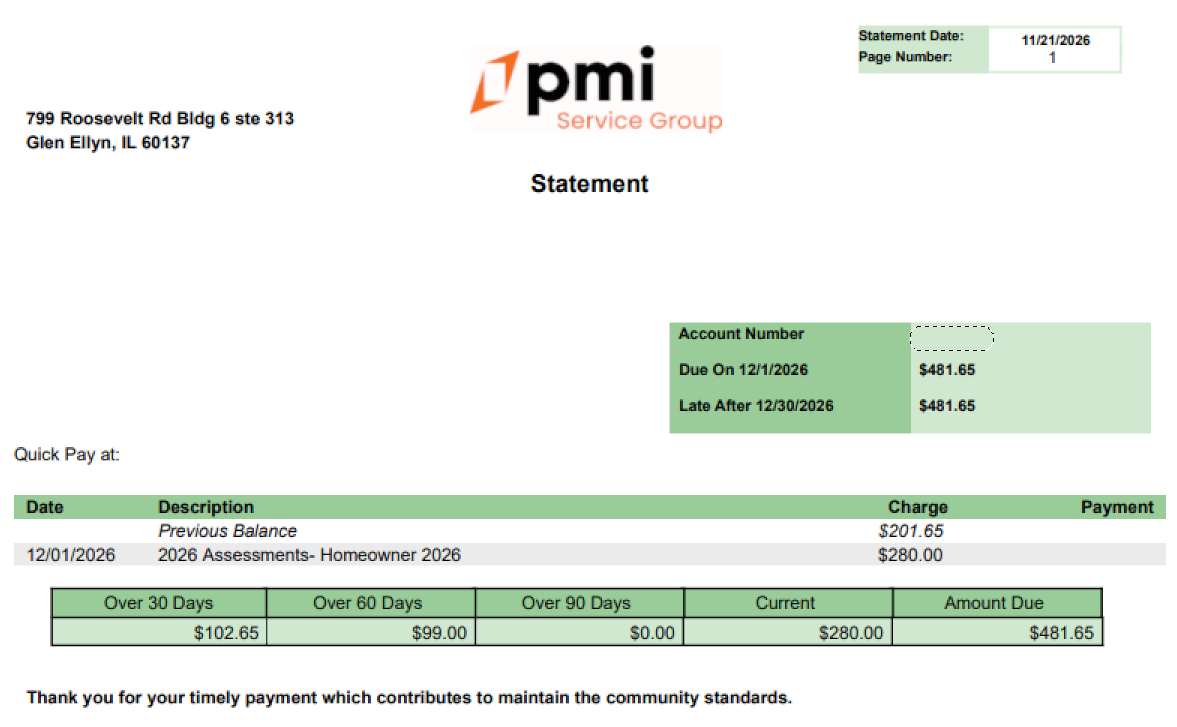 |
The statement shows a balance of $481.65 comprised of a current balance of $201.65 and a future charge on the first of the following month of $280.00.
The Aging table shows a $102.65 balance over 30 days and $99.00 over 60 days.
Unfortunately for the Owner, the statement has limited space on the page and does not include the historical transactional history to explain what these numbers mean. Before we do that, let's take a look at what the Aging is communicating to the recipient of the statement.
Understanding the Aging Report
Many association statements include an aging report that categorizes outstanding balances into several periods:
- Current: Charges not yet aged into a delinquency category.
- Over 30 Days: Outstanding balances aged beyond 30 days.
- Over 60 Days: Outstanding balances aged beyond 60 days.
- Over 90 Days: Outstanding balances aged beyond 90 days.
Even when homeowners consistently make payments, older charges may remain outstanding because of how payments are distributed.
Additionally, statements are often generated in advance of the upcoming assessment due date. As a result, a statement may include future assessments and may calculate aging using a reporting date different from the statement generation date.
Now looking at the transactional history:
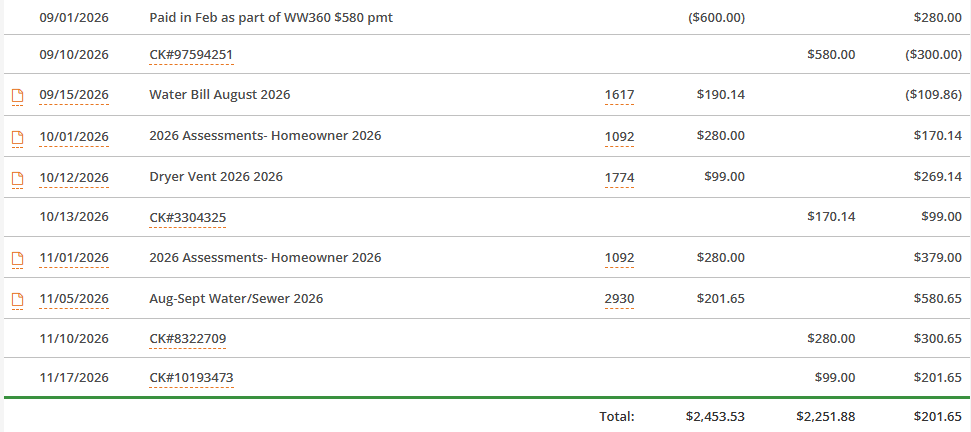 |
The "Aging" (length of time, or age, of the outstanding balance) takes into account all the charges, as the account was never at $0.00 since Sept 15th (9/15 when there was a credit of $109.86).
The statement was generated on Nov 21st, 2026, a Saturday, and the payment on Nov 17th likely didn't clear yet, hence 60 days looking out to Dec 1st when the statement "assumes" is the present date since it looks out past the 1st of the following month to include the upcoming assessment.
Additionally, pointing to the $99 it is technically still unpaid, since it is a charge type for "Dryer Vent" cleaning, that is less important than the monthly homeowner assessment charge, legal fees, water billing, etc. So even though the owner wrote a check for $99, and had the intention to pay the dryer vent charge, the system automatically applies it to a charge type that has a higher importance in the system.
So the $201.65 is currently sitting at $99 dryer and $102.65. How?
Let's start at October 13th. On 10/13 the balance was $99.00 (last column on the right). But on 11/1 and 11/5 new charges were added bringing the balance to $580.65
These are for monthly assessments and water reimbursement for utilities, both very important charges on the charge type hierarchy. So the next $280 and $99 payments were then applied to the hierarchy of charge types, bringing the balance to $201.65 but the $99 dryer vent, being the lowest priority on the list, is still considered unpaid - even though the owner may have had the intention for that check to be applied to that charge type.
Statements vs. Account Ledgers
A statement provides a financial snapshot, while an account ledger provides a more detailed history of individual transactions.
Homeowners should periodically review their complete account ledger through their association's online portal to better understand outstanding charges, payment allocations and account balances.
At PMI Service Group, we believe financial transparency and homeowner education are essential components of effective community association management. Understanding how association billing works helps homeowners manage their financial obligations and contributes to the overall financial health of their community.
About the Author
Paul is a founding partner of PMI Service Group and has more than 24 years of experience owning and managing investment properties in Illinois and Indiana. Paul manages the Association side of the business today, working with HOA homeowners associations, condominium associations and commercial properties throughout northern Illinois. His experience includes board governance, reserve planning, construction oversight, capital improvement projects, collections, and Illinois community association operations.
About PMI Service Group
Property Management
PMI Service Group manages residential rental homes, Associations, commercial properties and even commercial Associations. We also offer brokerage services for homeowners looking to sell their homes. We also conduct property acquisitions off-market, helping people who face foreclosure or private sales between real-estate investment clients looking to trim or add to their real estate portfolio(s). With many years of experience in construction, engineering, design, rehabs, investment property, property management and portfolio management, let's have a conversation about managing your Association.
Real-Estate Investors
We also conduct property acquisitions off-market, helping people who face foreclosure or private sales between real-estate investment clients looking to trim or add to their real estate portfolio(s).
Local Team
With many years of experience in construction, engineering, design, rehabs, investment property, property management and portfolio management, let's have a conversation about what good management really means. We're local and experienced and would love to hear from you.
PMI Service Group
630-912-8742